
Project Leaders
Project Personnel
Cooperators
To provide growers in south central Montana with a reliable, unbiased, up-to-date source of information that will permit valid comparisons among improved spring wheat varieties. This information should help spring wheat producers in south central Montana select varieties best suited to their particular area and growing conditions.
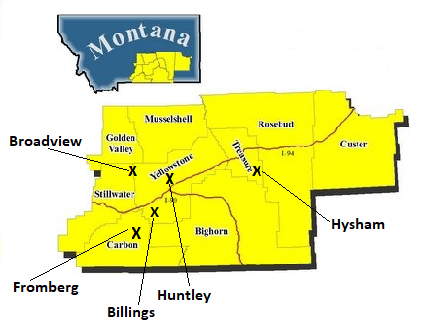
The 2021 off-station spring wheat trials in south central Montana were established under dryland conditions near Billings, Broadview and Huntley, and under irrigated conditions near Huntley, Fromberg and Hysham, Montana (Figure 1). The spring wheat trials for this region of Montana each possessed 25 entries made up of 15 commercial cultivars and 10 experimental lines.
All studies were planted using a partially-balanced lattice design with three replications. All entries were seeded at approximately 0.75 million seeds per acre under dryland conditions (~45 lb/a) and 1.5 million seeds per acre under irrigation (~90 lb/a). Seeding rates were not adjusted for germination.
Dryland test plots consisted of a 16-foot, 4-row plot with 12-inch row spacing, while irrigated plots were 16-foot, 7-row with 7-inch row spacing. All rows of each test plot were trimmed 36 inches and harvested using an experimental plot combine. Recorded grain yields were adjusted to 13% grain moisture content, and are reported in bushels per acre (bu/a) based on a 60 pound standard bushel weight. Test weight (lb/bu, pounds per bushel) and grain moisture content (%, percent) were obtained for each plot using a Dickey-John GAC 2100 grain analyzer. Grain protein (%, percent) was estimated using near infrared spectroscopy. Reported grain protein values are adjusted to 12% grain moisture content. Plant height was measured in inches from the soil surface to the top of the head, excluding the awns if present. Lodging severity was recorded on a 0 to 9 scale, at Huntley, Fromberg and Hysham, representing no lodging to all stems lying flat on the ground, respectively.
The 2021 spring wheat test sites had below average rain or snow accumulation during winter months except in October 2020. Below average precipitation was observed throughout the 2021 wheat growing season particularly during grain filling period. The precipitation during the months of March and April provided some moisture for spring wheat emergence and early stand establishment. Below average rainfall in June and July (0.4 and 0.1 inches respectively) coupled with higher than normal temperatures resulted in heat and drought stress during grain filling period that reduced spring wheat yield. The 2021 growing season was one of the hottest year on record. The average temperature during June and July was 6.4 and 5.1 0F above the long-term average.
Spring wheat yield at Huntley under dryland condition averaged 45 bu/acre in 2021 about 30 bu/acre less than last year (Table 1). Lower yield at this location this year was mainly attributed to heat and drought stress conditions particularly during grain filling period. The experimental lines ‘MT1938’ and ‘MT1939’ were the highest yielding entry with 55 bu/acre. Two other entries have the yield statistically equal to that of highest yielding entries. Spring wheat test weight averaged 55.9 lb/bu and all entries had test weight below 60 b/bu. Grain protein content was high averaging 17.0 percent and all entries have protein content over 14 percent. Averaged yield over the past two- (2020 2021) and three-years (2018, 2020 and 2021) was 61 and 65 bu/acre respectively. The cultivar ‘Vida’ had the highest yield averaged over the past three-years.
Dryland spring wheat yield at Broadview averaged 51 bu/acre in 2021 (Table 2), Cultivar ‘Dogmar’ was the highest yielding entry with 61 bu/acre. Five other entries have yield statistically equal to the highest yielding cultivar. Test weight was low and averaged only 57.1 lb/bu. All entries at Broadview had test weight below 60 lb/bu. Grain protein content averaged 18.1 percent and ranged from 16.1 to 19.4 percent. Averaged yield over the past two- and three-years was 48 and 54 bu/a respectively. The cultivar Dogmar had the highest yield average over the past three-years.
Spring wheat productivity was severely effect by heat and drought stress at south Billings dryland site this year. Spring wheat yield at this site averaged only 13 bu/acre compared to 59 bu/acre in 2020 (Table 3). ‘Vida’ and ‘MT1931’ were the highest yielding entries with 16 bu/acre. Thirteen other entries have the yield statistically equal to that of highest yielding entries. Test weight averaged 57.1 lb/bu and all entries had test weight below 60 lb/bu. Grain protein content averaged 17.7 percent. Averaged yield over the past two- and three-years was 36 and 31 bu/acre respectively. The cultivar Vida had the highest yield average over the past two- and three-years.
Relatively higher grain yield was observed for the irrigated spring wheat trial at Huntley which averaged 93 bu/acre in 2021 (Table 4). This location has the highest grain yield among locations tested this year. Grain yield ranged from 81 bu/acre for MT1931 to 107 bu/acre for experimental line ‘MT1904’. Sixteen other entries produced yield statistically equal to that of highest yielding entry. Test weight averaged 63.0 lb/bu and all entries have test weight of 60 lb/bu or more. Grain protein levels were high and averaged 14.7 percent. All entries had grain protein content above 13 percent. Grain yield over the past two- and three-years was 103 and 92 bu/acre respectively under irrigation at Huntley.
No lodging was observed for spring wheat entries tested in 2021 under irrigation at Hysham. Grain yield averaged 79 bu/acre and ranged from 68 bu/acre for ‘Choteau’ to 90 bu/acre for ‘MT1855’ (Table 5). Five other entries produced yield statistically equal to the yield of highest yielding cultivar. Test weight averaged 62.9 lb/bu, and all entries have test weight greater than 60 lb/bu. Grain protein was high averaging 15.3 percent and all entries had protein content above 13 percent. Average yield, over the past two- and three-years was 90 and 80 bu/acre respectively. Dagmar was the highest yielding cultivar over the past three-years averaging 88 bu/acre.
Like other irrigated locations tested in 2021, no lodging was observed for spring wheat at Fromberg. Irrigation was lost for a 2-week period in July at Fromberg. Grain yield averaged 77 bu/acre that ranged from 69 bu/acre for ‘Brennan’ to 87 bu/acre for ‘MT1809’ (Table 6). The grain yield of ‘MT1934’ was statistically equal to MT1809. Test weight averaged 61.5 lb/bu and ranged from 59.7 to 63.3 lb/bu. Grain protein content averaged 12.4 percent and ranged from 11.5 percent to 13.7 percent. Two- and three-year average yield for spring wheat varieties tested at Fromberg was 94 and 95 bu/acre respectively.
Below average precipitation and above average temperatures were observed throughout the 2021 wheat growing season. Drought and heat stress particularly during the grain filling period caused severe spring wheat yield loss at most of the dryland test sites. Dryland grain yield averaged only 36 bu/acre (Tables 7 and 10), while it averaged 84 bu/a under irrigated conditions (Tables 7 and 9). Dagmar was the top yielding commercial cultivar with 43 bu/acre not only under dryland conditions (Table 10) but also average across all location tested in south central Montana (Table 11). Two experimental lines MT1938 and MT1939 yielded similar to Dagmar. ‘WB9879 CLP’ was the top yield cultivar under irrigation averaged over the past two- and three-years (Table 9). Averaged across locations grain protein content was 15.9 percent. Test weight averaged 59.6 lb/bu over all locations (Table 8), and averaged 62.4 lb/bu across irrigated locations (Table 9).